The Designer’sConstitution
A model for thinking about what makes someone a designer in the age of AI, laid on the foundations Walter Gropius set for the Bauhaus and adapted by PabloZarate™
To decide, or not to decide…
To design is to decide what should exist, what it will be made of, who it is for and what it will cause, and the word has meant that since long before anyone drew a screen. Whoever makes those calls is the designer, with or without the title or the training.
So when someone celebrates that AI will finally free designers to focus on strategy and leadership, I suspect they understand little about design and even less about strategy or leadership.
That seat has always been there. What’s new is what we’re getting back.
Newsflash: designers regain command of technology.
This is not a revolution. It’s a Renaissance.
What AI changes is how close a designer can get to the material. Code, data, models and distribution are now within reach of anyone who designs, and with them comes command over what actually gets built.
And we needed one… Treating everything as minimum and viable led to poor ways of working, and the industry filled up with mediocre (vanilla) and overcomplicated products.
This is a chance to fix that and make experience the differentiator again. But to do it, a designer has to master and understand where the material (technology) they choose to work with breaks.
There is no experience without conscious practice.
Bauhaus
To understand what’s coming, first look back
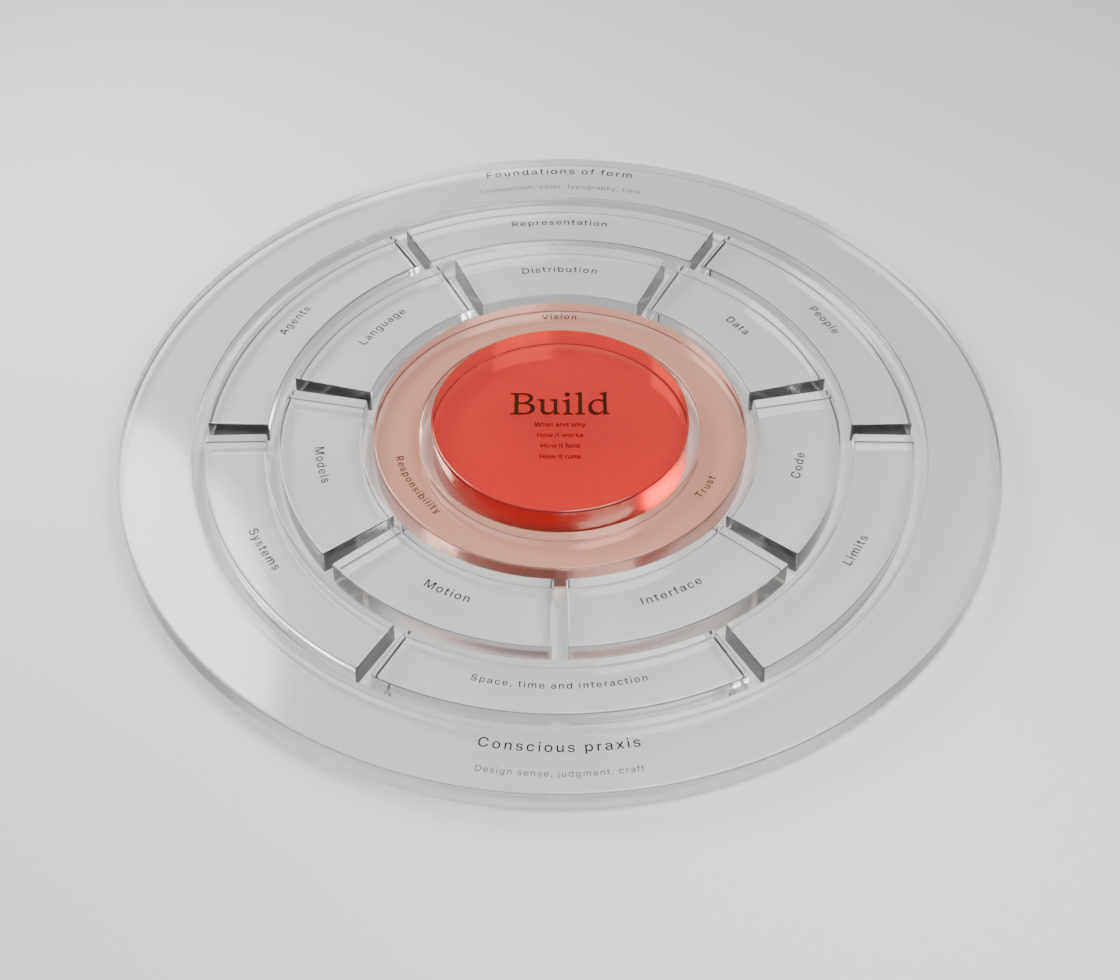
In 1922 Walter Gropius designed the Bauhaus curriculum as a set of concentric rings.
On the outside, the foundational concepts. In the middle, the workshops for understanding materials: stone, wood, metal, clay, glass, color and textile. And at the center, Bau: building, the synthesis of everything before it.
Every apprentice worked with two masters at the same time, one for the craft and one for form. The workshops became laboratories for the prototypes that industry then produced in series.
Defining the form of a lamp or a chair meant knowing the metal and the wood it would be made of.
The Designer’s Constitution reimagines that drawing for the work of today. It is a framework that orders the essentials every designer should have in this new Renaissance of the profession, brought on by AI.
Building at the core.
Ring 01
The ground
The outer ring has two halves: the grammar of form, which holds in any medium, and conscious praxis, which is what turns hours of work into experience.
Form follows function.
Ring 02
Studies
What a designer studies to understand a problem before solving it. Gropius started with observation, the study of nature and of materials, and a good part of the craft is still learned that way: Japanese joinery fits wood together without nails, and temple carpenters place each piece according to the direction in which the tree grew.
Massimo Vignelli put it in three words, design is one: a map, a dinner service and a house get designed with the same judgment.
Anyone who can design one thing well can design anything.
Ring 03
Materials
Digital design works with seven materials. Gropius gave each of his a workshop because each one is worked differently and breaks in its own place, and the training in those workshops already included bookkeeping, pricing and contracts. Wood splits along the grain, code in the case nobody tested, a model in the question nobody saw coming.
Knowing a material means knowing where it breaks.
Ring 04
Non-negotiably Human
Three things must remain human. Everything else can be automated.
Every task can be delegated, except thinking… Thinking is not a task, it’s a privilege.
Ring 05
Build
When building becomes cheap, designing intent is what sets the work apart.
This is the new baseline.
There are no shortcuts… and that’s a good thing.
Nothing is settled yet, but one thing is clear: design is not just a profession, it is a mental model that adapts to its time.
Building well takes judgment. This Constitution sets out the capabilities the person who designs must understand and master, whether or not they carry them out themselves.
But judgment can’t be prompted. There are no skills for it, no magic app… It takes sitting down and learning by doing, by building. There are no shortcuts.
The future belongs to designers who build.
My bet on the future
I see a new wave of founders with a design background, one-person companies and solopreneurs who take seriously how design improves people’s lives.
Every transition produces plenty of garbage before it settles, and this one will produce its own. That will be a chance for juniors to learn by fixing all that vibe-coded slop.
The future belongs to designers who build.
Always be shipping.